Every surfer knows the reef walk. One eye peeled on the lineup, and the waves (hopefully) crunching, roping or sliding down the reef. The other eye downcast, picking a line between urchins, toe-stubbing boulders, and ankle-wrenching potholes. Many surfers consider that just dead ground; an obstacle between you and the ocean and a surf.
Except it turns out something else does that exact walk, on purpose, for a living. Somewhere off the southeastern coast of Papua New Guinea, in the kind of skinny, knee-deep reef water you’d normally just stumble straight over, there’s a shark doing push-ups across the seafloor. Not swimming. Walking. On its fins. Like it’s got somewhere to be and swimming is, like, so last millennium.
Meet Hemiscyllium dudgeonae, better known as Dudgeon’s walking shark, the newest member of one of the ocean’s strangest and least-known family trees, and a reminder that the water surfers cross every single day to get to the good stuff still has secrets in it.
Now the idea of a new species of shark suddenly being able to skip across land at pace could be slightly alarming. This is about as far from a Jaws as sharks get. No vendetta, no “massive man-eater” energy. It’s also not a genetically engineered mako shark made hyper-intelligent and enormous as in the Deep Blue Sea. Dudgeon’s walking shark ain’t Hollywood fodder (it hasn’t even been in a tornado). It didn’t get smarter or bigger; it just got a name.
That was due to a team led by researchers Jess Blakeway and Christine Dudgeon from the University of the Sunshine Coast who found the new species during night dives in Milne Bay in 2025, and published the findings in the peer-reviewed Journal of the Ocean Science Foundation last month 2026.
Milne Bay is a large bay in Milne Bay Province, in the south-easternmost corner of Papua New Guinea. The region is world-famous for crystal-clear waters, making it easy to pair small-scale surf or kiting explorations with world-class scuba diving and WWII historical sites, exactly the kind of clear, shallow, reef-heavy water where something like a walking shark could go unnoticed for as long as it has.
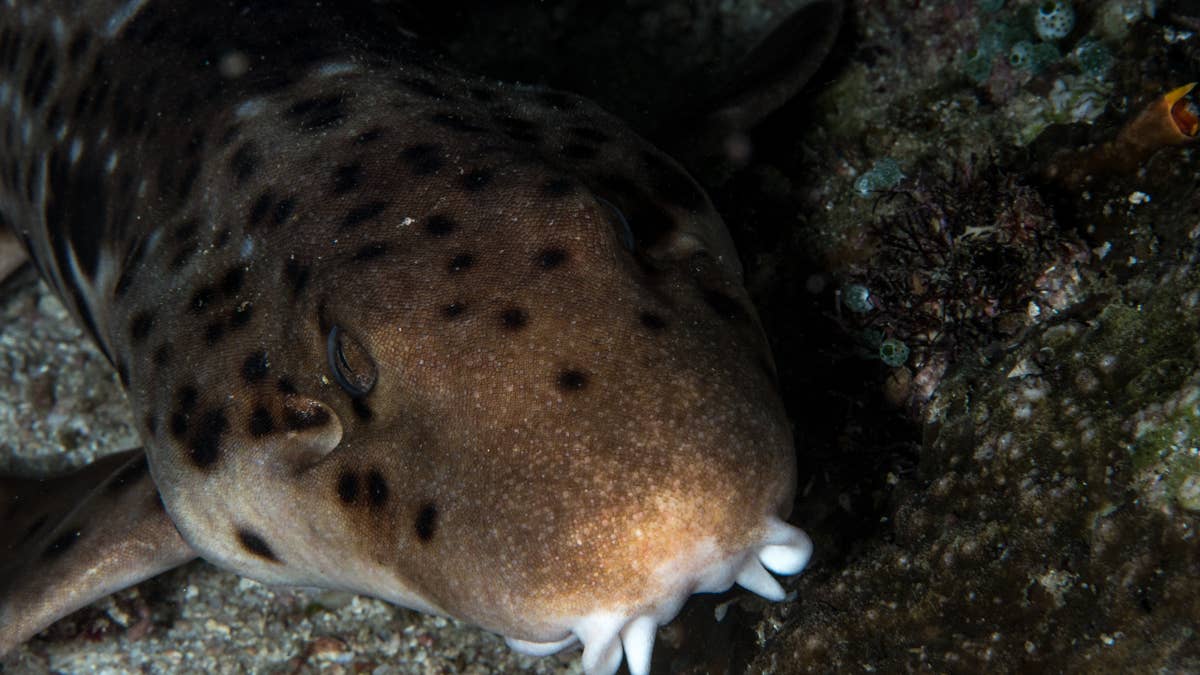
Dudgeon’s walking shark itself is part of the epaulette shark family; small, harmless reef sharks named for the dark shoulder-spot markings that look like military epaulettes, and it tops out at about a metre long. Barely bigger than a decent-sized snapper.
Related: Surfer Attacked at Shark Bite Capital of the World
What makes it “walk” isn’t a metaphor. Epaulette sharks use their paddle-shaped pectoral and pelvic fins almost like limbs, hauling themselves across shallow reef flats and even between tide pools at low tide. Terrain that would leave most other sharks stranded. Dudgeon’s walking shark does the same, cruising the shallows hunting small invertebrates, built for a world of ankle-deep water and exposed coral rather than open ocean.
So they aren’t new, but when Blakeway pulled one out of the water, she immediately clocked that something was off. Instead of the usual leopard-style spots, this one was covered in scattered white dashes; a pattern she later said reminded her of braille, or Morse code. Over the next two nights they found eleven more individuals with the same markings, and it went from, in scientific terms, “what the fuck is this”, to “new species” in the space of about 48 hours.
Mind you, the local villagers weren’t that impressed. They’ve apparently had a name for this thing for a long time. They call it kadedekedewa, roughly translated as “dog shark” or “lazy shark,” a nod to its slow, deliberate crawl across the reef. As ever, Western science just took a few hundred centuries to catch up.
However, in what probably isn’t a surprise, the walking sharks are both rare and vulnerable. I mean, the design flaw is fairly obvious. Dudgeon’s walking shark lives in a tiny, specific stretch of reef, which means coastal development, fishing pressure, and warming water can all hit its population hard, precisely because there’s nowhere else for it to retreat to. Five of the ten known walking shark species are already considered threatened for exactly this reason. Researchers are heading back out in October to gather more data before recommending it to be put on the high risk of global extinction list.
For surfers, its good to know that a six foot shark isn’t about to rear up and start chasing you across some coral or reef to have a nibble pre surf. Shark attacks in the water are already enough cause for concern. But it is worth remembering that you aren’t tip-toeing over an empty, dead space, but instead passing through a living, barely-mapped ecosystem, and apparently one that’s still turning up entirely new species in 2026. Next time, if you see a shark walking, don’t keep it to yourself.