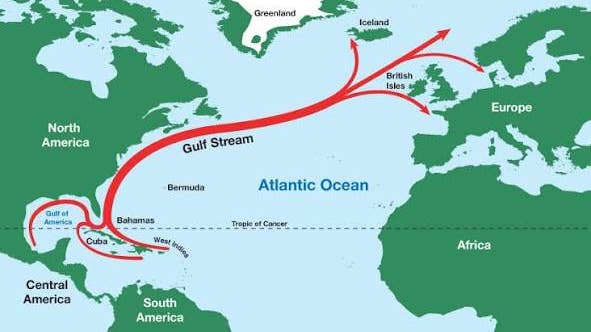
For years, the Gulf Stream has been the oceanographic equivalent of a person at a party whispering, “The Atlantic circulation is slowing down,” before disappearing into the crowd and leaving everyone else to panic.
Now, apparently, it’s speeding up—and NOAA is starting to think there’s a little more pattern than chaos at play after all. A new NOAA study found that the Gulf Stream underwent a rapid intensification from 2014 to 2023. Researchers analyzed 31 years of satellite-altimeter observations, from 1993 through 2023, and found a prolonged period of weakening between 2005 and 2014, followed by a pronounced acceleration. So much for the simple version of the story.
The new research also found that the Gulf Stream didn’t merely get faster: It shifted northward and became more stable and less meandering. NOAA oceanographer and study lead Shenfu Dong put it nicely: “The Gulf Stream’s story is far more dynamic than a simple slowdown narrative.”
Importantly, this study is looking at the free-flowing Gulf Stream after it separates from the coast, downstream of Cape Hatteras—not declaring that the entire Atlantic circulation has suddenly hit the gas. In fact, NOAA notes that the upstream flow through the Florida Straits remained relatively steady.
And for surfers, the question is obvious: What does this mean for the waves? Well, possibly something interesting. But not necessarily something as simple as more Gulf Stream = more surf. The Gulf Stream is already moving at a pretty good clip, carrying vast amounts of warm water northward along the East Coast before turning northeast into the Atlantic. And moving water matters to moving waves.
When a current runs opposite the direction of a swell, it can make that swell steeper and more closely packed. The Gulf Stream’s interaction with storm-generated waves can therefore affect not only wave height and steepness, but direction.
Related: The 1983 El Niño Destroyed California’s Coast — Could It Happen Again? (Video)
During Hurricane Matthew in 2016, for example, researchers found that the Gulf Stream altered the storm’s wave field, producing zones of wave steepening and changing incoming wave directions at the coast by as much as 20 degrees. In other words, the Gulf Stream doesn’t make waves. It can, however, mess with the ones that are already on their way.
For East Coast surfers, that distinction is worth remembering: A stronger, more northerly Gulf Stream could alter the way storm-generated swells propagate across the western Atlantic, particularly when those swells encounter the current at an angle. Depending on storm track, current position, wind direction, and bathymetry, that could mean steeper seas offshore or subtle changes in where and how storm energy reaches the coast.
But let’s resist turning this into a surf forecast. The NOAA study does not establish that a faster Gulf Stream means more hurricanes, nor that a slower one means more Nor’easters. The relationship between the current, atmospheric circulation, storm tracks, and wave climate is considerably more complicated than that.
Related: Atlantic’s Sargassum Problem Is Reaching Record Levels
There are still some intriguing implications for anyone who spends an unreasonable amount of time staring at the Atlantic. NOAA says a faster Gulf Stream can transport more heat toward higher latitudes, “warming the upper ocean and increasing heat released into the atmosphere,” per a press release announcing the study’s findings. Its strength and position also influence weather patterns, sea levels, marine ecosystems, and climate around the North Atlantic.
And warmer water is hardly an academic concern for surfers. Tropical systems can draw energy from warm ocean water, while changes in storm behavior can mean changes in the swell machine. More powerful storms can mean more potential surf—but also more destruction. That old double-edged sword.
For ocean nerds, there’s another bit of good news: The Gulf Stream is proving considerably more dynamic than the old shorthand suggests. It weakened for nearly a decade, then strengthened rapidly. It shifted south, then north. It became more unstable, then more stable. And scientists can now watch those changes in extraordinary detail using decades of satellite observations. For surfers, that’s another variable added to the already ridiculous equation governing whether Saturday morning will be firing or flat.
Storm track. Wind speed. Fetch. Pressure gradient. Water temperature. Swell period. Bathymetry. Tides. And now, apparently, the behavior of a giant river in the sea. So no, the new study doesn’t tell us whether next winter will deliver more barrels at Montauk, cleaner lines in the OBX, or another season of waiting around in New Jersey for something—anything—to happen. But it does give us another reason to keep an eye on the Atlantic. Because the Gulf Stream is moving. And when one of the North Atlantic’s biggest currents changes its speed, position, and shape, the waves may have something to say about it, too.