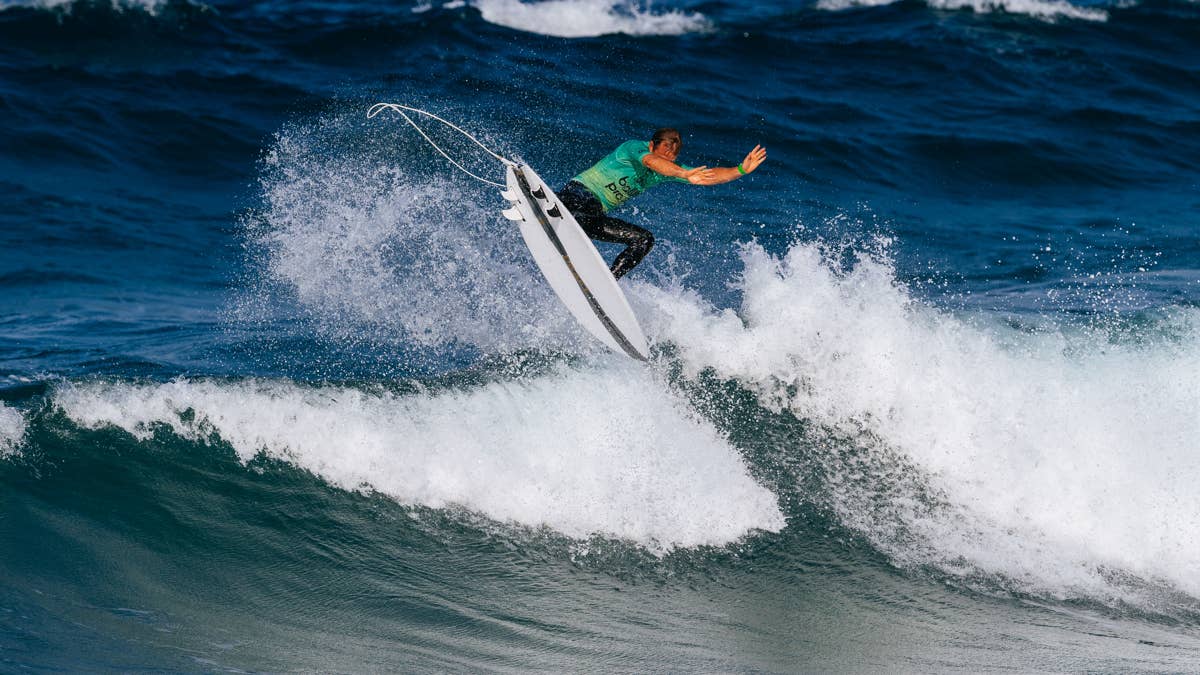
As a brash, aerial-pioneering teenager, Josh Kerr lived a fast life fueled by punk rock and party culture. He was the last person you would expect to see in a boardroom. Fast forward to today, and Kerr is one of the sharpest minds in the surf industry.
From lucrative exits with Saint Archer and Balter to launching Draft Surfboards, Kerr has a powerhouse entrepreneurial track record. His latest play is helping bring the highly anticipated DSRT Surf inland wave park to market, all while guiding his daughter Sierra’s rapid rise in the pro surf ranks. We called Kerr up to dig into his early inspirations, his biggest business gambles, and the art of managing a chaotic global life.
Note: Last week we spoke with CJ Hobgood about his pivot from the Championship Tour to building Salty Crew, and eventually finding a new competitive thrill in real estate sales. This interview with Kerr is the second in an ongoing series featuring professional surfers that have made hugely successful inroads in a variety of industries.
SURFER: In the early 2000s, pro surfing was flush with industry money, but nobody was really teaching you guys about investing and portfolio diversification. What inspired you to think about life and investing while you were still so young?
Josh Kerr: To be honest, my inspiration came from moving to America with a young family. I was 24 and I had a three year old when we moved, and I was living in a place where I didn’t have childhood friends. So I was hanging out with new friends with young kids and most of them were in their 30s or 40s already, and they were much more money savvy than me. I was having different dinner conversations in America compared with being in Australia when I was growing up with the Hazza twins [laughs].
I never got any of that financial advice from family, or anything like that; everything was very paycheck-to-paycheck my whole life up until that point. I don’t think I realized it at the time, but it’s so important who you surround yourself with; good conversations lead to so many good opportunities.
Great point. But having an opportunity is one thing, actually taking the risk and getting involved as often as you have is another.
I have a very open-minded mentality towards life, including the financial side of things. I’m a bit of a risk taker, and because of that I’ve definitely had plenty of losses, but few big wins as well. The main thing is, I try to create my own opportunities. Like with Balter — that was our business that we built. It was definitely risky but we had some control over the outcome. It’s not like the opportunity came to us. That’s a lot different from investing in someone else’s dream, which I’ve done my fair share of as well. Some of my worst investments have been investing that way. A lot of those are just lottery tickets. These days, I don’t really invest in anything unless I know I can involve myself and add value to it that way.
You mention Balter, which was a huge success. On the flipside, is there a business you invested in that didn’t work out?
Oh yeah, and I’ve learned so much through it. There was VNDA [pronounced “unda”], the loungewear brand. I started it with a group of people in 2011; it was my college of sorts. We went through the process of creating it, brought on investors, figured out the logistics, and brought it to market… and it didn’t pan out. It eventually sold for pennies on the dollar. But I learned so much during that process.
You win or you learn, right?
Yeah, even though it was a good seven years of just throwing money into thin air [laughs], it was so helpful in the long run. You learn you’re never the smartest one in the room, you learn to listen to diverse ideas, and you learn how to be a chameleon. I’ve got so many friends from different parts of life, but I appreciate being around all of them, and I enjoy taking ideas and inspiration from all over the place.
Fast forward to today and you’re juggling a surfboard brand, family life, Sierra’s career, chasing waves, and new ventures like DSRT Surf. How do you manage your time? Is it ever overwhelming?
Yeah, well there’s definitely times where I’m like, shit, I need to be putting more energy into this area or that… but by design, I can do pretty much everything I do, without having to be anywhere specific. Does that makes sense?
Totally.
The way I’ve designed my life, I feel like I can add value in all these different places, so even when things get really busy I enjoy being a part of it all. Sierra is 19 years old, and it’s so fun traveling with her. If she would have really pursued the skateboarding side of things I’m not sure how I’d feel about the places we’d be traveling [laughs]. Now it all feels natural and familiar. But it took a long time and a lot of lessons to get to this point where I can bounce between chasing waves in Indo to spending time with the family while also working at DSRT Surf and having things flow naturally.
Speaking of DSRT Surf, how did you get involved with the project?
DSRT Surf was one of those lottery tickets that actually worked out. It was an awesome idea that came to me 10 years ago, back when wave pools were very, very, new and there were a lot of proposed projects, very few of which came to fruition. From the beginning, I believed in the area, and I believed in the passion and experience behind the people that were involved in it. As we’ve seen with wave pools, a lot of them don’t happen— there’s a lot of moving parts, they’re very capital intensive, there’s a lot of logistics and permitting and all that kind of stuff that goes in to make one of these a reality…so yeah, I got lucky getting involved with this crew and this project. At the same time, I knew I could add value to the project from the beginning, so it was really a no brainer for me
In my opinion, there’s no better place in the world for a wave pool, because it’s an easy drive for 60% of the surfers in California, plus it’s always sunny, it’s beautiful, and I just love the desert in general — I like the whole desert rat side of things [laughs]. Growing up I was into motorbikes and off-roading and all of that. Plus I love golf, so it really couldn’t be a better fit for me personally.
The Wavegarden tech is tried and true and people already love and trust it. But a couple of other things that people may not know: This is the second largest Wavegarden in the world, meaning you can run more frequent sets of waves. Also, the soft liner on the bottom is unreal. Expand a little on that key feature.
The soft liner with the padding is a game-changer, as you know. I’ve been flexed on the bottom on a couple of waves, especially during the slab setting — and if it was breaking on a hard cement bottom, I probably would have gotten hurt. The bottom out there is so comfortable that I would say the rate of injury will be so much less than in any other pool. You can bang your elbow or your knee or your back or the back of your head, and the bottom actually gives way.
It felt like I was sliding on a kid’s playground underwater.
Exactly. And I think that’s something that is going to be a huge thing for that pool and for the progression of the sport.
Speaking of progression: You can run the five wave air section set in a public setting. How do you think that impacts the future of the sport?
Yeah, once we have it fully dialed and have that public air section running, that’s going to be huge for everyone from the dad that just wants to know they can still do airs, to the kids learning how to do an air for the first time. In most pools you have to book private sessions to hit ramps and then they aren’t able to run as many waves, whereas this one we can run five waves with ramps and reset them pretty quick.
Related: I Tested California’s Newest Manmade Wave: Is DSRT Surf Worth the Hype?
Another thing you mentioned is that despite surfing it for hours each day, you weren’t bored with it. You were backdooring the slab, skipping the tube to launch airs, and exploring different lines on every wave.
Yeah, I wasn’t even close to bored. I went straight to DSRT Surf from Kandui in the Ments. The whole family just jumped in the RV. We were worried about how hot it was going to be out there, so I figured we’d surf a bit and then drive back to our place in Carlsbad every few days to kind of wash the desert heat off.
But once we got there, I didn’t even think about leaving for the entire three weeks. Not even once. Once you’re in the water, the temperature is a perfect 80 degrees, and with the dry desert air, it feels magic. There’s so many different waves and so many different lines you can create surfing on them. It’s endless actually. I honestly didn’t even think about going back to the coast to go surfing even though it was pumping around home the whole time. I was so amused by what we were doing out there it wasn’t even a thought in my mind.
It kinda sounds like you enjoyed surfing in the desert for three weeks as much as you enjoyed your trip to Indo.
[Laughs] Honestly, I did. And I’m itching to get back. There’s something so rad about seeing all the smiles on everyone’s faces after surfing out there.
Is there an official opening date yet?
No, no date yet, but we’re very, very close. Just some city stuff to sign off on that should happen soon. It’s kind of just a moving target at this point, anywhere from a few days to a few weeks. I’m excited for everyone to have a shot at it soon.
Related: Interview: How Many Realtors Have a World Title on Their Resume?