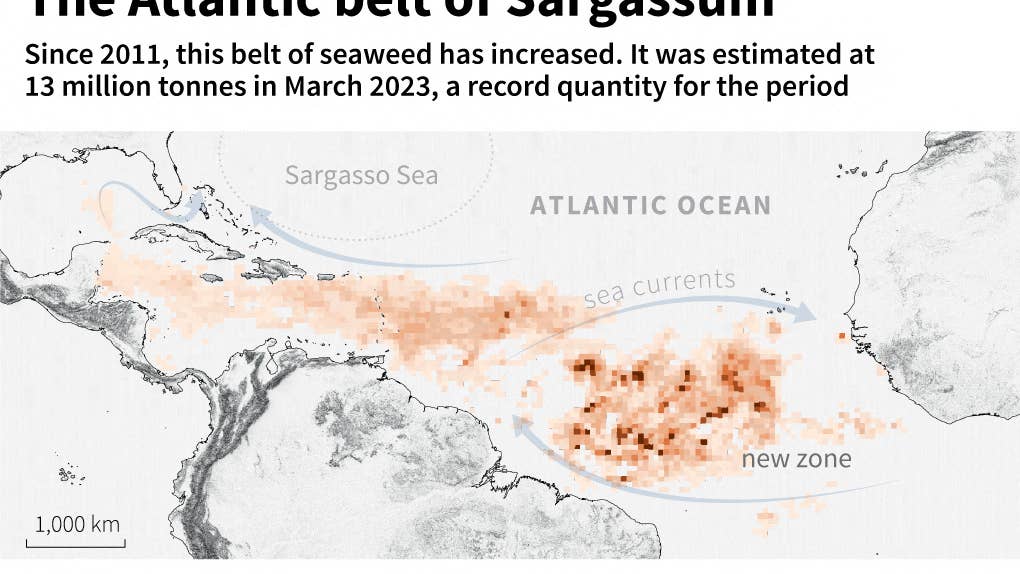
We recently covered the increasing tonnage of sargassum and the effects it has had on coastlines and surfers in the tropical Atlantic and Caribbean. Miami spends $9 million a year scraping the toxic, rotten-egg-gas belching stuff off its beaches. Tulum’s restaurants are reporting a 60 per cent drop in sales. A Surfer correspondent was face-planting on the stuff at the end section of his local point break. It’s easy to file all of that under “unlucky geography” — an unfortunate current system dumping a record 37-plus million tons of seaweed on one unlucky stretch of coastline.
Yet research by the University of South Florida’s College of Marine Science, working with NOAA’s satellite research centre (STAR) and researchers from Columbia’s Lamont-Doherty Earth Observatory, USC, and San Francisco State, suggests we may be zooming in too much on sargassum. The team trained a deep-learning AI model to scan 1.2 million satellite images spanning 2003 to 2022, hunting across 13 ocean zones for five distinct categories of floating algae.
Even with the use of powerful AI tools, it took several months of processing on USF’s high-performance computing cluster just to get through the dataset. The headline was that while between 2003 and 2022, floating microalgae increased by a modest but statistically significant 1 per cent per year globally, floating macroalgae; the big, visible mats like sargassum, increased by a whopping 13.4 per cent per year in the tropical Atlantic and western Pacific specifically. The macroalgae blooms’ cumulative footprint reached 16.9 million square miles, which is larger than the continent of Asia, or nearly 30% of Earth’s entire land surface. It’s an increase described by the authors as one that broke sharply with historic trends, with the steepest growth kicking in after 2008.
Before 2008, there were essentially no major macroalgae blooms reported anywhere except sargassum in its native Sargasso Sea. Lead researcher Chuanmin Hu’s zoomed right out to look at the global picture. “The world’s ocean may be undergoing a regime shift from a macroalgae-poor ocean to a macroalgae-rich ocean,” he said.
Related: Atlantic’s Sargassum Problem Is Reaching Record Levels
The broader tipping point for macroalgae blooms globally was around 2010. This means the sargassum belt wasn’t an isolated freak event; it was one visible symptom of a worldwide shift happening at the same time. The study attributes the expansion to a combination of human-driven nutrient runoff into coastal waters and climate variability, mainly ocean warming. However, the researchers noted this wasn’t a one-size-fits-all approach; the exact balance of causes likely differs region by region rather than having one universal trigger.
The researchers stress floating macroalgae isn’t purely bad news out in the open ocean; it can provide valuable floating habitat and nursery grounds for fish, exactly as we’ve seen with sargassum supporting mahi mahi and turtles offshore. The problem is specifically when these mats drift inshore and hit the coast, where decomposition brings foul-smelling gas releases, ecological disruption, tourism damage and the clogging of surf spots already well documented in Brazil, Mexico, the Antilles and Florida.
For surfers, the practical read ain’t great: the sargassum-tracker habit that’s become second nature for a Riviera Maya trip may need to become standard practice well beyond the Caribbean-Gulf corridor. The Atlantic belt is a semi-contained story; one weedy villain, and one stretch of ocean. This study suggests it was never really contained at all, just the first bloom that was big, smelly and close enough for surfers and everyone else to notice.