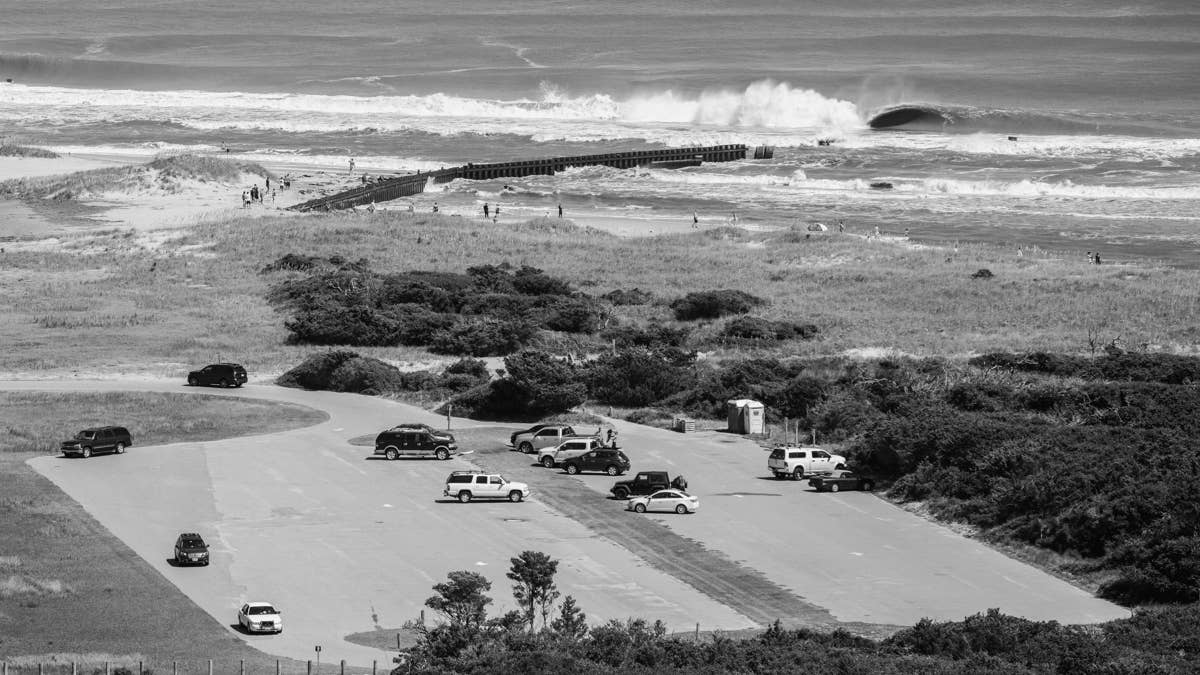
It’s arguably the most iconic surf spot on the East Coast. And as of this month, it will never be the same. Then again, it was never really the same to begin with. Coastlines are constantly changing, particularly remote, sandy barrier islands like North Carolina’s Outer Banks, where the Atlantic has been moving sand, and reshaping lives, for centuries.
This week, demolition began on the famed First Jetty groin at Hatteras Lighthouse in Buxton, North Carolina. The deteriorating structure will be replaced by a new groin as part of a larger effort to stabilize a rapidly eroding stretch of shoreline. For surfers, it marks the end of an era.
The Lighthouse
Cape Hatteras was long known as the Graveyard of the Atlantic, a treacherous stretch of coastline responsible for countless shipwrecks. Unlike coastlines anchored by rock, this one is essentially built on sand, constantly rearranged by storms, currents and swell.
The first lighthouse was erected in 1794 and rebuilt several times. Groins, more commonly known as jetties, were eventually added to help protect the structure and hold the shifting shoreline. The current lighthouse was completed in 1870. By 1940, the area had become part of the Cape Hatteras National Seashore.
As surfing spread along the East Coast, it was inevitable that surfers would discover Cape Hatteras. The area was exposed to swell from virtually every direction, while the doglegged groin blocked north winds and helped organize the sand and surf. The lighthouse became a symbol of the break and, eventually, of East Coast surfing itself.
In 1971, the Eastern Surfing Association held its Eastern Championships at the Lighthouse, launching a storied 30-year run at the spot. In 1999, the Hatteras Lighthouse itself was moved 3,000 feet southwest to protect it from the encroaching ocean. For generations of surfers, however, the groins were what made the wave.
“The Lighthouse is an iconic East Coast spot,” says North Carolina surfer Brett Barley. “There’s an era of guys who know how good it was in its prime with complete jetties and no crowds, with a perfect peeling left hander coming off it.”
The Wave Changes
But the wave, like the island, has never stopped evolving. Storms and erosion battered the groin system, while permitting work on National Park Service land became increasingly complicated. Sand began moving through the deteriorating structure, and the beach changed from season to season. For a while, so did the wave.
“The next era saw the demise of the groin system begin, and with it, the wave,” Barley recalls. “But at some point, in the late 2000s, it rebirthed a whole new type of wave.”
The new Lighthouse was less user-friendly and considerably more intense.
“There was far more current, much steeper drops, and way thicker lips,” Barley says. “The perfect peeling barrel for most abilities turned into ‘expert only,’ below sea level tubes on its ripest days.”
Even that version eventually changed.
“Each generation of surfers that has grown up riding waves at the Lighthouse has their own idea of what perfection was,” Barley says. “And I think we can all agree it used to be better than it is now.”
The wave’s final act came during the 2024-25 season, when the old groin briefly produced something resembling its former magic.
“First Jetty’s swansong was the last seasons of 2024/25, where we got a glimpse of its old self again—reeling hollow tubes,” Barley says. “And due to beach closures, it was mostly just the local crew.”
For him, there was something poetic about it.
“It was a poetic way for the structure to wrap up its years buried in the sand, grooming the waves for us.”
Daniel Pullen
When the Ocean Came for Buxton
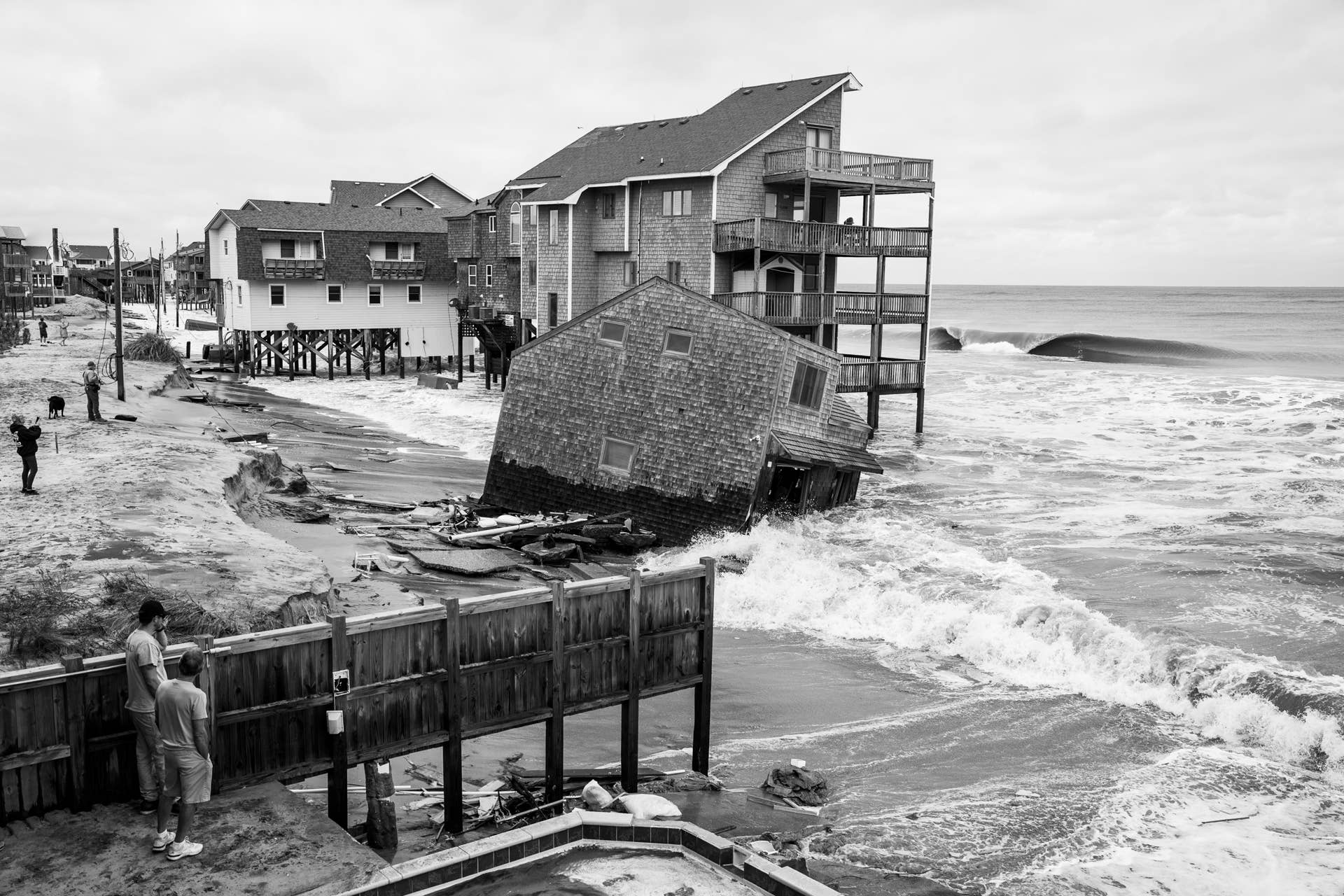
The same storms that shaped the surf were also destroying the shoreline. In 2018, Weeks Marine completed a first round of beach replenishment as the ocean began encroaching on Buxton’s waterfront neighborhood. But with the groin continuing to deteriorate, the protection was temporary. Then came a succession of nor’easters and active hurricane seasons.
Last September, houses began falling into the Atlantic. By October, eight were gone. By June, the total had reached 20. Local residents rallied to remove debris and support one another. Photographer and longtime Buxton resident Daniel Pullen documented the destruction, while locals formed the Buxton Civic Association to advocate for help at the state level.
It’s easy from a distance to dismiss the homes as vacation properties built too close to the water. But the reality is more complicated. Many were modest two- and three-bedroom beach houses built decades ago, passed down through families and rented during parts of the year. Those visitors support the local economy, filling restaurants, surf shops, fishing charters, rental properties and other businesses. As Barley points out, the houses also represent something less tangible.
“People say, ‘those are just houses,’ but they mean something,” he says. “They were memories for those families and us.”
The erosion also threatens something even more fundamental: access. On the north end of town, there was eventually nothing between NC Highway 12 and the Atlantic. During major storms, Buxton, Frisco and Hatteras could potentially be cut off from the rest of the world, putting their local economies at risk.
Daniel Pullen
A New Era
With the shoreline collapsing, the North Carolina Department of Environmental Quality issued Dare County another permit for beach replenishment. Great Lakes Dredge & Dock Company began pumping sand on July 31, with approximately 2 million cubic yards contracted for the project. The goal is to fortify the beach, protect infrastructure and buy the community time.
Now comes the next phase. The old First Jetty is being demolished and will be replaced by a new groin. What that means for the wave is anyone’s guess. Beach replenishment and groin construction have long been controversial among East Coast surfers. Structures designed to protect communities can fundamentally alter the sandbars and, in some cases, destroy the waves that drew people there in the first place. In Buxton, however, the local surf community is largely supportive.
“With the collapse of the jetty has also been the shoreline collapse of the village of Buxton,” Barley says. “They are now going to repair the jetty, finally, in hopes to shore up some sand on the north side to protect the highway and provide some stability for years to come.”
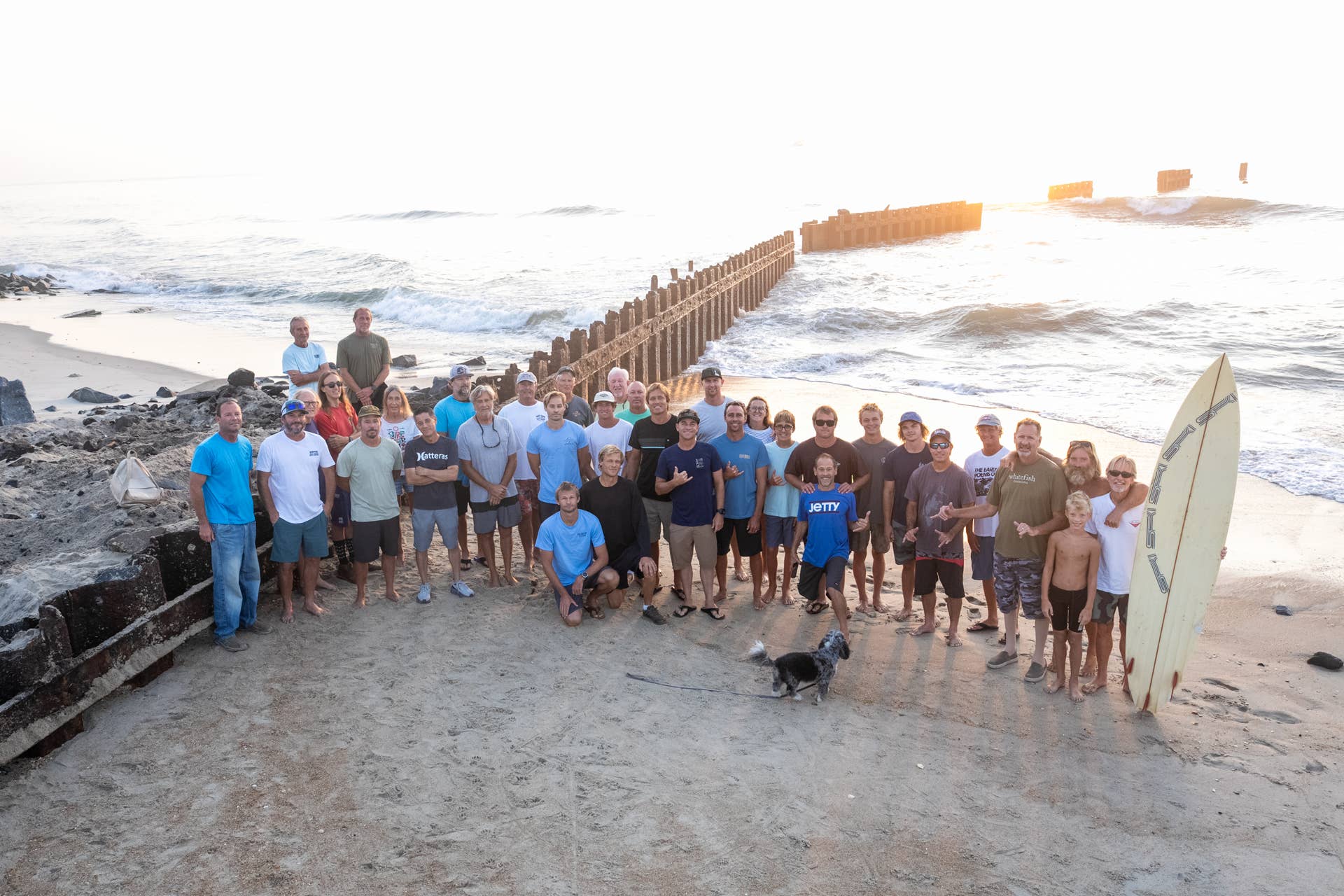
The day before demolition began, local surfers gathered at the First Jetty, a structure that had become more than a piece of coastal engineering. It was part of the community’s identity. For surfers, the moment was bittersweet.
“It means our wave won’t disappear forever,” Barley says. “It will have yet another rebirth.”
But there’s no going back.
“We can all agree, it’ll never be the same as it was with three steel groins grooming sets from the northeast, to provide endless barrels for those who grew up or drove in here.”
The Lighthouse, as generations of surfers have known it, is gone. But on a barrier island, perhaps that’s the only thing anyone can really count on.
“One thing you learn early in life on a barrier island,” Barley says, “is that the only thing constant about it is change.”