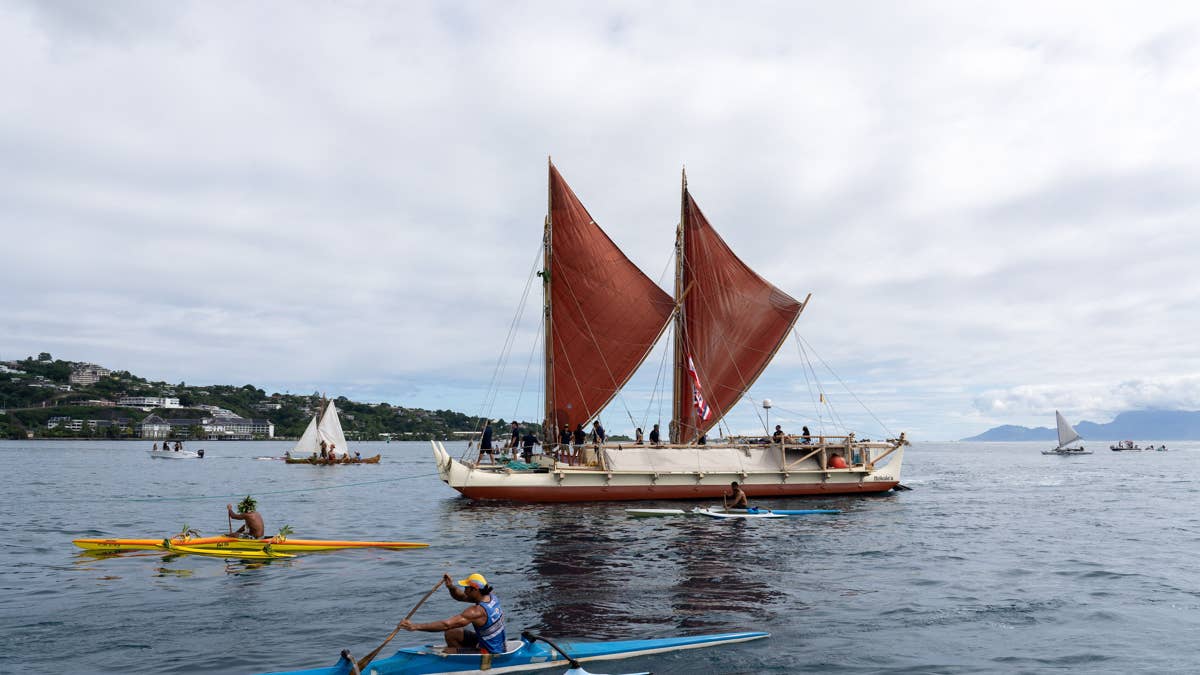
Eddie Aikau’s story might be the best known in surfing. We’ve all been brought up on the heroic act. Surfers know that Eddie was one of 16 people who boarded a canoe bound for Tahiti. A few hours later, in rough water in the Kaiwi Channel, the double-hulled canoe flipped. Everyone clung to the upturned hull through the night.
Eddie, one of Hawaii’s best big wave riders and the most respected lifeguard on the North Shore, asked twice for permission to paddle for help on his surfboard. At first light, the crew joined hands in a prayer, and he went. He paddled toward Molokaʻi. The Coast Guard found and rescued the rest of the crew. Eddie was never seen again.
That story might have been one of surfing’s more heroic footnotes if it wasn’t for the Eddie Aikau Invitational, which started in 1984 and has since become one of surfing’s most prestigious events. The event and its iconic imagery – Flea Virostko dropping from a 20-footer, Bruce Irons packing a 10-foot shorebreak, a win by local lifeguard Luke Shepardson in some of Waimea’s biggest-ever surf- have kept Eddie’s heroic act at the centre of surfing culture for more than 40 years. “Eddie Would Go” became a slogan that glued his act of bravery into the sport’s lore.
And yet while that selfless act has had its candle kept alight, what many don’t know is that the canoe Eddie left, the Hōkūleʻa, has had a remarkable history and an influential legacy that far surpasses Eddie’s tragic death. And it’s nowhere near done yet.
One of Eddie’s crew members on the 62-foot-long, 20-foot-wide double-hulled canoe that night was a 25-year-old navigator-in-training named Nainoa Thompson. He had watched Eddie paddle into the distance.
“After Eddie’s death, we could have quit,” Thompson said afterwards. “But Eddie had this dream about finding islands the way our ancestors did and if we quit, he wouldn’t have his dream fulfilled.”
Not long after, Thompson went to Satawal, the tiny Micronesian island home of master navigator Mau Piailug, who had guided Hōkūleʻa to Tahiti in 1976 using no instruments. Teaching an outsider broke tradition, but Mau agreed anyway, telling Thompson, “I will train you to find Tahiti, because I don’t want you to die.”
In 1980 Thompson navigated Hōkūleʻa from Hawaii to Tahiti and back, the first Hawaiian in roughly 600 years to cross that ocean by the old methods: stars, swells, birds, wind.
Since then the Hōkūleʻa has sparked a massive revival of Hawaiian and Polynesian culture, language, canoe-building, and traditional navigation across Oceania. In 1987 it completed a two-year, 16,000-nautical-mile loop of Polynesia, including Tahiti, the Cook Islands, Aotearoa, Tonga and Samoa. In 1999, the crew made it to Rapa Nui, the most remote corner of the Polynesian Triangle. Between 2014 and 2017 it stopped at more than 150 ports and travelled 40,000 nautical miles, using only traditional navigation, carrying a “care for the Earth” message.
Thompson turned 73 in March. He and the Hōkūleʻa have spent the past year in Auckland. They are roughly halfway through a clockwise circumnavigation of the Pacific that began in 2023. The current leg is stalled by the same El Niño that has everyone in surfing watching the Pacific and that, ironically, might see the Eddie run in record waves this winter.
In a June video message, Thompson said the sail plan would be “adjusted to what nature allows us to do.” The plan had been for Hōkūleʻa to reach Fiji around mid-October for the Pre-COP climate meetings, then Tuvalu. Gales and cold fronts held them in Auckland in late September, and the Fiji and Tuvalu visits were postponed, potentially until May 2027. The revised schedule adds a year to the circumnavigation, which now runs into 2028.
Thompson, as ever, takes this as an opportunity. “This is not a delay. It’s not a setback. To me, it’s a stepping stone of learning,” he announced. Beyond the Pacific islands, the crews are weighing a 6,400-mile leg toward Hokkaido, which would be Hōkūleʻa’s first visit to Japan in about 20 years, against a return to Aotearoa, which Thompson says his research shows is the safest place in Polynesia during a strong El Niño.
The Hōkūleʻa is on a schedule set by weather and the stars, not by a calendar. Most of what makes it work is caution: open-boat sailing with no instruments. Thompson is a leader who learned early what a bad night costs. He has spent the past four decades turning a tragedy into a navigation school, with the ultimate goal of training and building a community of 10 million navigators. These are the crew that will carry the lesson forward: sometimes you go, and sometimes the ocean says wait. Eddie’s dream was to find islands the way the ancestors did. The canoe he paddled away from is still looking. That could be his greatest legacy.