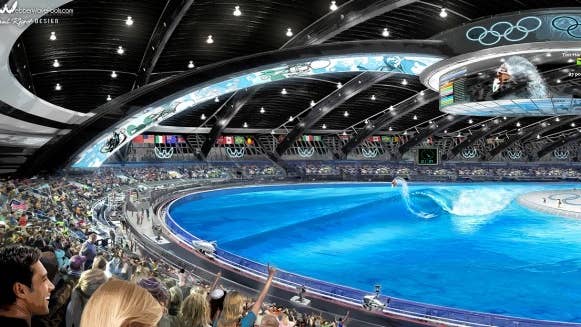
Imagine catching a single, perfect wave and riding it endlessly. This surfing fantasy hinges on a rare physics phenomenon known as the soliton wave, or non-linear wave.
According to a comprehensive study in the National Center for Biotechnology Information, “A soliton, or solitary wave, is a type of self-reinforcing wave packet that continues to propagate at a constant speed and retains its original shape.”
Translation: a never-ending wave. Recently, the YouTube channel The Action Lab recreated this bizarre physical anomaly in a controlled setting. See below.
Using a mechanical sled in a 20-foot water channel, the host successfully generated a stable soliton wave. Unlike normal waves that dissipate quickly, this localized wave traveled the full length of the tank and rebounded back with virtually no change in its form.
The discovery of these seemingly never-ending waves dates back to 1834 when Scottish naval architect John Scott Russell observed a “Great Translation Wave” in a shallow canal. He noted that the wave continued to move at a constant speed without losing its shape, defying normal wave mechanics. They occur in nature when a wave’s natural tendency to spread out perfectly balances against its steepening effect.
So, can a surfer actually ride a never-ending soliton?
While natural tidal bores offer incredibly long rides, wave pools may hold the ultimate key. However, traditional linear lagoons are fundamentally limited by their physical length. In the past, visionary pool designers have proposed concepts for infinite rides.
Greg Webber’s circular infinity wave model was an ambitious design that promised an uninterrupted, peeling wave circling an island indefinitely. Unfortunately, that specific concept never came to fruition. At least not yet.
Still, as wave pool tech continues to rapidly evolve, the dream of surfing a continuous wave remains alive. Until someone builds that infinite circular lagoon, surfers will just have to marvel at the weird physics of solitary waves in the lab.
One day, maybe one day.
Related: Three-Dimensional Rogue Waves Reach 65-Feet in Open Ocean (Video)