
Editor’s Note: For the last two weeks of October, Red Bull Surfing hosted two weeklong Waves of Consequence training camps in Nazaré: one for their “Rising Stars” under-18 prospective athletes, followed by their big wave team. The camps overlapped by a few days to offer mentorship and camaraderie across the generations.
The group chat pinged steadily throughout the day to relay training sessions, meal plans, rides, surf conditions and, of course, jokes. Like when Eric Rebiere posted a clip of an 8-foot barrel at Praia do Norte with the comment “high tide”.
Natxo Gonzalez replied, “1-foot Hawaiian.” Laughing emojis followed.
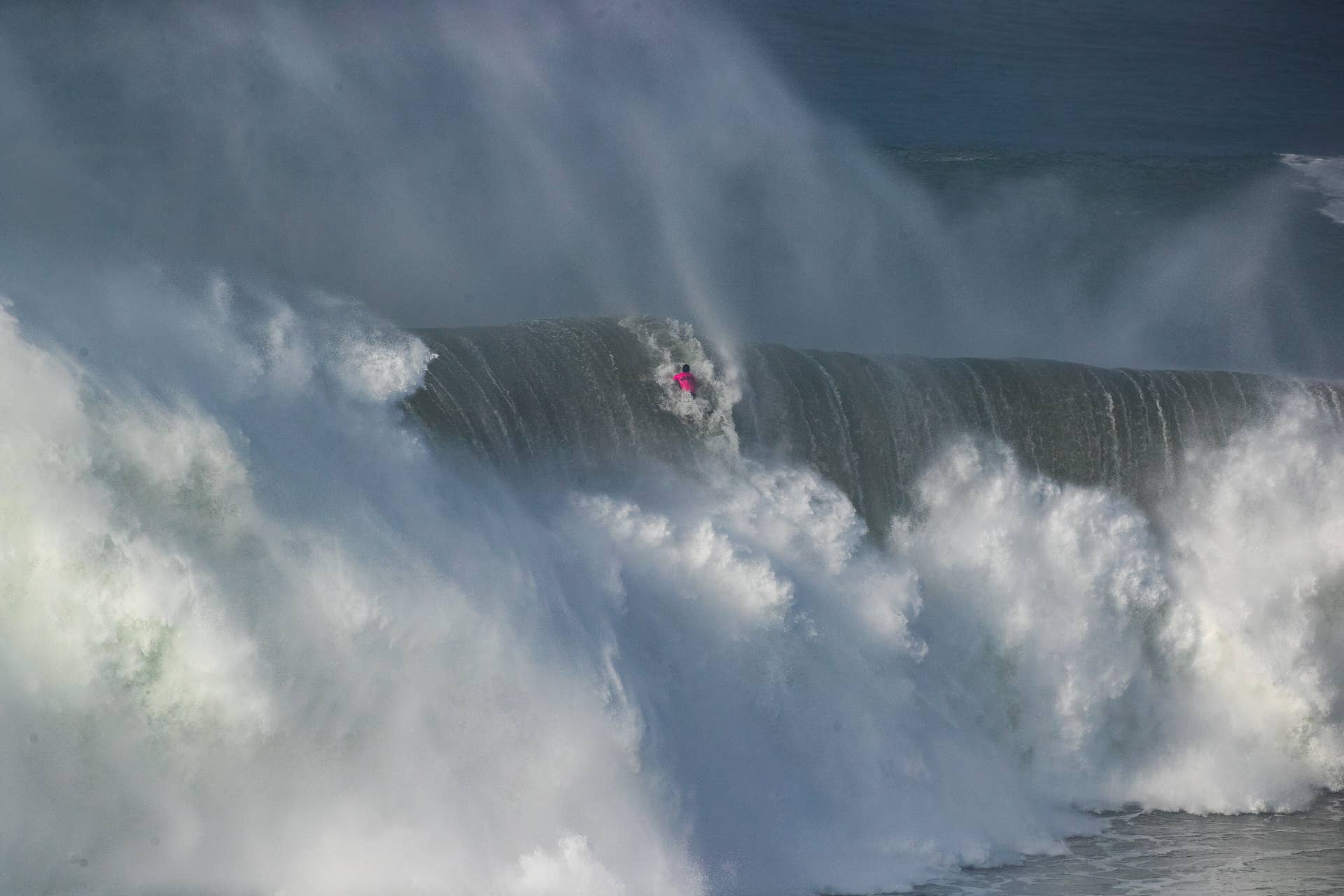
Once the tide dropped and the crew was on the beach, we could see the waves were easily double-to-triple overhead, breaking just offshore in shallow water, and mostly closed out. The only joke then was, “So, who’s keen to paddle out?”
They may be elite athletes, but they’re still mortals. The Nazaré shore break has a way of transforming froth into fear, no matter who you are. Despite the circumstances, Natxo and Kai Lenny hit the water and packed a few barrels before the conditions shifted yet again.
The pyramid peaks were still coming in, only more chaotically. The inside looked like a turbulent soup of sand and whitewater. From that point on it was a tow session, tame by Nazaré standards but perfect training for the under-18 group who were there for their final day of the development program.
Team managers Stan Fiess and Miky Picon planned the overlap between the camps so the future stars could learn from some of the best big wave surfers on the planet like Kai, Natxo, Justine Dupont, Andrew “Cotty” Cotton, Pedro “Scooby”, Dominique Charrier, Lucas “Chumbo” Chianca, Lucas Fink, and Carlos Burle. The exception being two teenagers, Koa Fabbio and Kamiel Deraeve, who were invited to join the second week as they’re both surfing well beyond their years in heavy water (you can expect a profile piece on each to come in the following weeks).
What transpires across the generations is priceless, from the surfers themselves, to the pilots like Tahurai Henry and Eric Rebiere, on down to the youngest athletes who are barely in their teens. Whether it’s Justine mentoring the young girls how to best hang onto the sled through violent whitewater, or Carlos pulling on experience obtained from decades of chasing heavy surf, it’s unlike any other training program in the world.
Perhaps the greatest thing about being on team Red Bull, beyond the prestige and financial support, is the behind-the-scenes healthcare available to the athletes. From strength and training, to nutrition, to mobility and mindset, to breath work and project preparation (like aerial training for new tricks, à la double backflips), and access to specialists. In the case of Natxo, that meant treatment in Switzerland after sustaining two concussions, one in Puerto Escondido and the other at Nazaré, that nearly ended his career.
Damien Poullenot
“You should have seen him here two years ago,” said Stan, “he couldn’t even jump on the trampoline. But he was smiling and happy to be here with the team for support.”
Clearly, it was worth it. Not only did Natxo regain his ability to live a normal life, after months of dizziness, depression, nausea, headaches, and light sensitivity, he came back to big waves. His paddle wave at Mullaghmore last season earned him the Wave of the Year at Big Wave Awards.
“Honestly, I don’t know where I would be without Red Bull. They didn’t give up on me, they helped me get my life back.”
When I asked Natxo about his recovery, his typically gregarious energy became serious. He looked down, took a moment, and then looked me in the eye and said, “Honestly, I don’t know where I would be without Red Bull. They didn’t give up on me, they helped me get my life back.”
Elite training
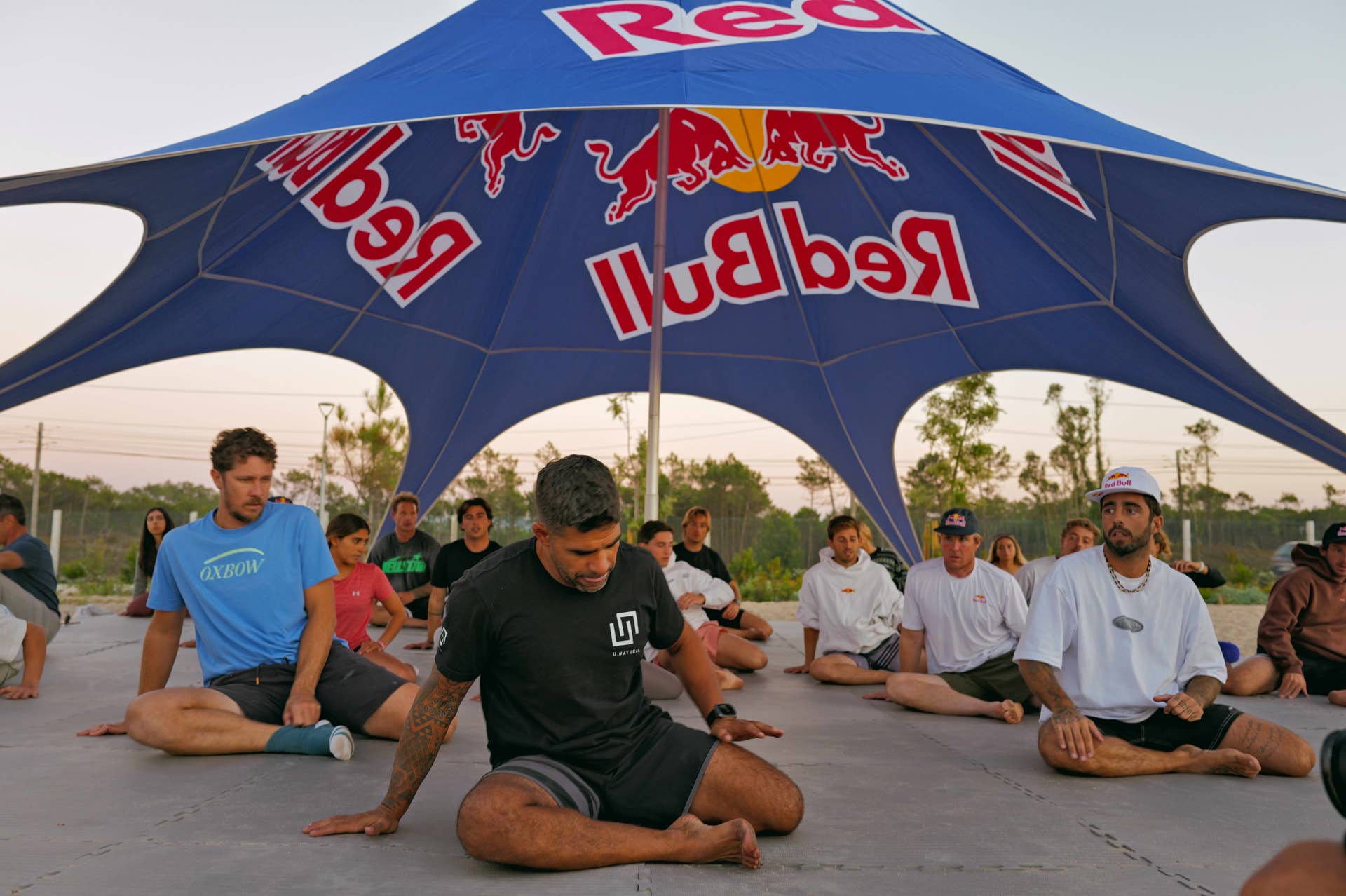
Due to early morning high tides and heavy fog, each day started with a training session led by Raphael “Rapha” Romana, Founder of U Natural Movement. In addition to being Filipe Toledo’s trainer and working with professional MMA fighters, Raphael has led workshops and training sessions around the world.
Chris Dodds
His training, which was originally developed by his father, is a specialized form of ginástica natural, a Brazilian movement method focusing mainly on physical work and breathing techniques. While it draws on techniques similar to those found in yoga and jiu jitsu, it enables muscle connections that most methods miss. As Rapha says, “The idea is to provide all the stimulus that you would experience surfing, which is unique compared to other sports, and prepare you for dynamic movement.”
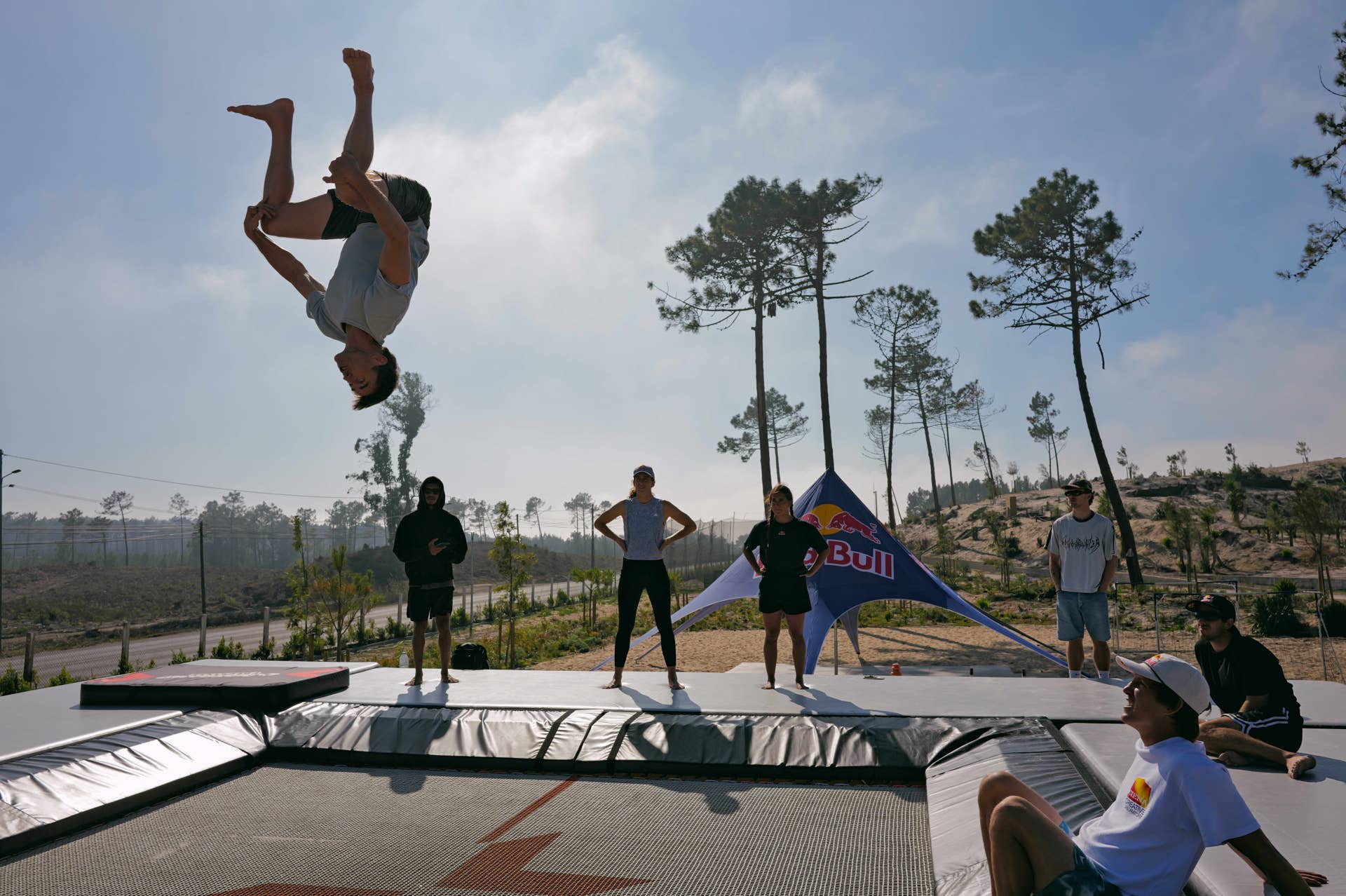
Also on offer was trampoline aerial training by Trennon Paynter, former competitor and renowned Olympic coach for both Canada and Australia. These sessions ranged from simple air awareness and center of balance exercises to specific training for new tricks. In the case of Kai and Chumbo, this means preparing for corked rotations and, hopefully, surfing’s first ever double-backflip.
Chris Dodds
For Red Bull, this constitutes as “project preparation”, which can take many forms across their spectrum of disciplines. “Surfing is so close, I mean so close to breaking through to a whole other level of maneuvers,” Trennon explained over lunch in Nazaré. “Within a few years it will really be amazing to see all of the new tricks that are going down.”
Perhaps most important for waves like Nazaré, Mavericks, and Pe’ahi (Jaws) were the apnea and breath work sessions held throughout the week. Led by João “Jojo” Perisot, founder of Wave Crushers Training System, the pool-based training prepared the athletes for big wave hold-downs and stress responses, increasing their maximum breath holds while building low-oxygen tolerance and teaching them to manage underwater disorientation.
While most big wave wipeouts are, on average, only about 15 seconds long, they can be far more intense depending on the situation. Just check the clip above from Kai for his POV after a big wipeout at Nazaré.
When taken together, the training camp is an ideal setting for the surfers to really prepare for the coming season and to sync up with one another. When surfing waves of consequence, the most important thing is trust, both in yourself and whoever’s got your back.
Related: Beyond the 100-Foot Waves: Nazaré’s New Ocean Experiment