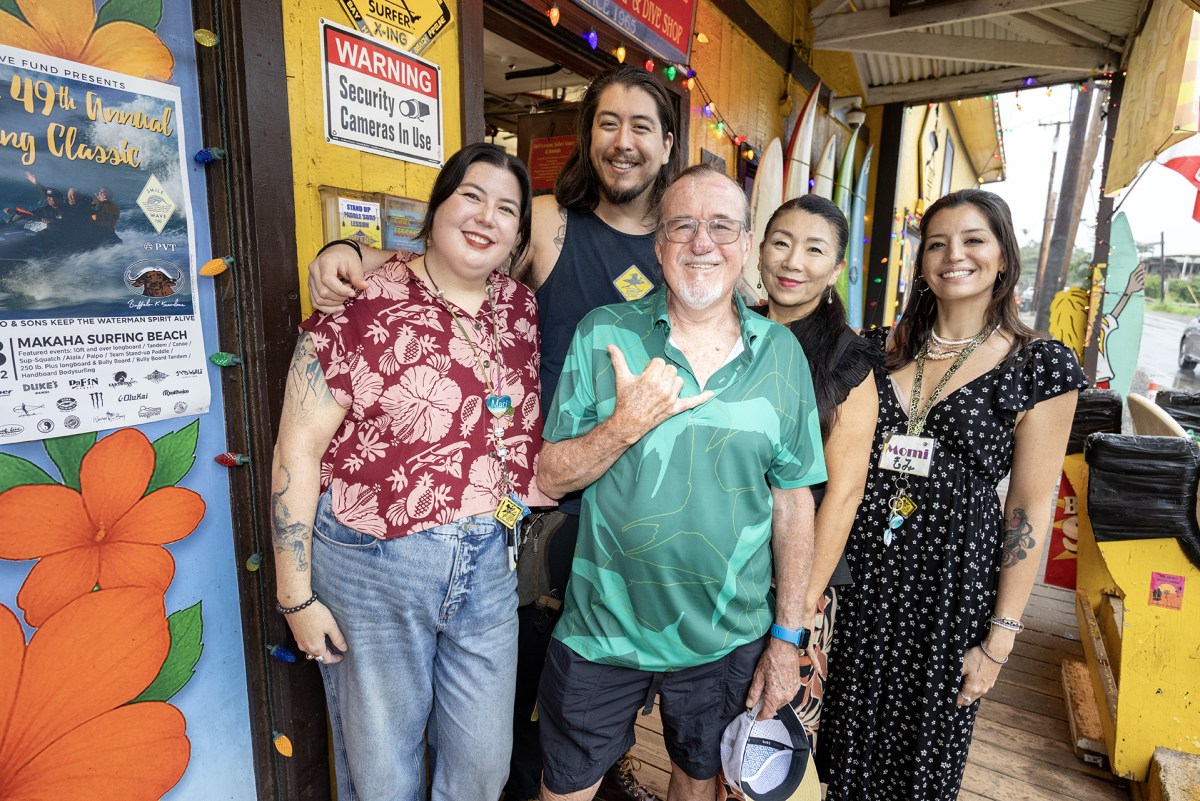
By Kaea Latronic – Just after five in the morning, Haleʻiwa still belongs to the ocean. Moored boats rolling gently, gulls cawing, the air is cool enough that steam curls off the river, but the sand is still cold. The beach is dotted with early-rising fishermen, paddlers of scattered ilk: canoe, board, outriggers. Sitting beside the old triple-arched bridge, there’s a building that has watched as Haleʻiwa changed in tidal shifts: sugar fields giving way to surf culture, plantation storefronts became boutiques. Catching the first wash of gold light across its sun-worn siding lies a yellow house, Surf N’ Sea, like a beacon.


There are landmarks you recognize by sight, and then there are the ones you know by feeling, part of the town’s muscle memory. The structure itself predates the surf era, built around 1921 it served every purpose a community could need. When surfing surged through O‘ahu in the 1960s, tourism cracked open the North Shore. The building officially opened as Surf N Sea in 1965. The shop moved through a few owners, but its iconic modern era took shape in 1982 when Joe Green, a Florida transplant with a nose for business and saltwater culture, bought into Surf N Sea and eventually took over. Part retail hub, part surf museum, part waystation for every type of waterman, waterwoman, wanderer. Walk inside, and it hits you. Boards stacked like history books, hints of decades-old stories lining the walls. The merchandise updates, but the energy hasn’t changed: nostalgia and momentum.
The Green family has kept Surf N Sea’s footing in a graceful balance. It fits perfectly into the North Shore’s cultural ecosystem: businesses built on relationships, families at the helm, a deep understanding that ocean lifestyle is not a marketing angle but a living reality.
The shop’s legacy isn’t just in being Hawaiʻi’s oldest surf-and-dive shop. The yellow house grew up with Haleʻiwa, held the line as surf culture found its voice. We got a chance to ask the Greens who have run the business with a mix of grit, instinct, and aloha, “how did you get there?”
FSM: When you first stepped into Surf N Sea, what made you believe it could become something legendary?
Joe: I walked in around 1982, and the building was in really bad shape. It had even been condemned years earlier. The floors sagged when you walked across them. But the location was great, the building was big, and the rent was cheap. I knew it was worth saving.
Naoko: Even back then, the building felt historic.
FSM: What were the biggest challenges running the shop?
Joe: Storms and the ocean. Hurricanes, flooding, and big winter surf were constant worries, especially before the breakwalls were built.
Naoko: Another challenge was staffing. Hawaiʻi is expensive, and housing is hard. A lot of people moved here with good intentions but couldn’t afford to stay.
FSM: Was there a singular moment when you realized Surf N Sea was more than a business? They often become unofficial community centers. When did that happen here?
Joe: As old buildings around Haleʻiwa were torn down, people started to see Surf N Sea as something worth protecting. Over time, it became a local landmark. We sold gear, filled tanks, and rented equipment. Surfers, divers, fishermen—everyone came through here. It became a gathering place naturally.


FSM: What values guide you in running the shop? Tell us about balancing tension between tourism and respecting local surf culture.
Joe: Giving back to the community, even in small ways. The Christmas Giveaway started over 30 years ago. People grab a free Surf N Sea sticker and put it on their car. During the 12 days before Christmas, if I spot the sticker around town, they win prizes. We call it “the sticker that keeps on giving.” Locals needed to feel taken care of, and visitors needed to understand how things work out here—especially surf etiquette and ocean safety.
Naoko: We value every customer. In the water, the right gear can save your life, so giving good advice really matters. We take care of locals and welcome visitors too.
FSM: Raising your kids around the shop, did you imagine they would step into roles? What did you want them to understand about maintaining it? And, finally, what makes you most proud?
Naoko: Back then we were focused on day-to-day life. Seeing all three of [our kids] working here now means a lot to me. So many historic buildings in Haleʻiwa are gone. Keeping Surf N Sea standing means protecting the town’s history, not just running a store.
Joe: The building is the business. That historic building by the bridge is a big part of why Surf N Sea exists. It needs constant care, a million into repairs. Preserving it isn’t optional—it’s essential. When they were little, no—I didn’t think that far ahead. Now all three of my kids are working here, and I’m super proud. The building is still standing, the fact that it’s still a family-run shop. Seeing my kids carry it forward means everything to me.
FSM: What are your earliest memories of Surf N Sea?
Mari: Some of my earliest memories are being a kid playing hide-and-seek in the racks of the shop, listening to the staff talk story, and playing pretend on the beach out back. The shop wasn’t just our family business—it was our second home, our safe space, and a major part of our childhood.
FSM: When did you realize your family’s shop was iconic in Hawaiʻi surf culture?
Mari: When I saw how internationally known we were. On family trips to Japan, we’d see people wearing Surf N Sea shirts. Families would return year after year, and local customers would tell me they’d been coming here longer than I’ve been alive. It’s a strange feeling when something so personal—so deeply tied to your identity—is also shared by people all over the world. There’s pride in that, but also weight.
FSM: What roles are each of you playing today? How did you choose your lane?
Mari: I focus on operations, hiring, and stepping in wherever the shop needs me most. Momi, our little sister, has been back at the shop this past year, and it’s been really special having her home and back on Team Green. We naturally fell into our lanes by leaning into our strengths. I studied psychology, so I gravitated toward the people-focused parts of the business. Momi has always had a strong eye for merchandising, and she’s recently stepped into the women’s buyer role. Joey thrives in customer service—he makes people feel instantly welcome.
FSM: What have you learned from stepping into leadership while your father is still present?
Mari: My dad’s experience is irreplaceable, and the transition has been gradual—him slowly handing more responsibility over to us. Eddie, our longtime GM, has also been an incredible guide. Our long-term staff plays a huge role as well. Their support means everything to us.
FSM: When you look ahead, what do you want to preserve? What do you want to evolve or modernize?
Mari: The heart of Surf N Sea—the warmth, authenticity, and sense of belonging. I want people to walk through the doors and feel the same familiarity and connection that generations before them felt. Evolving doesn’t mean replacing what’s special—it means strengthening it.
FSM: What does surf culture mean to you today? Surf N Sea is deeply woven into Haleʻiwa’s identity. How do you maintain that relationship?
Mari: It means history, respect, and what bridges together our community. I’ve learned you don’t have to be in the water every day to love surfing. You can be a spectator, an admirer, and still feel deeply connected to the culture. Haleʻiwa has given so much to our family, and we carry a responsibility to give back. I’d love to expand youth water-safety programs, mentorship opportunities, and cultural initiatives led by local practitioners. Helping our keiki build confidence, connection and kōkua feels deeply important.
FSM: Was there a moment when the shop began to feel like yours? What part of your family legacy feels light, and what part feels heavy?
Mari: In many ways, it will always feel like my parents’ shop. I’m simply grateful to be part of the legacy they built—something strong, meaningful, and worth protecting. The light part is the pride—knowing how much this place means to so many people. The heavy part is the kuleana: the responsibility of protecting and continuing something that existed long before me and will continue long after.
FSM: What does success look like for Surf N Sea in the next 10 to 20 years?
Mari: Success means staying rooted and relevant. A strong, happy team. A connected community. A modern operation that still feels authentically North Shore Haleʻiwa. And a legacy our keiki can one day carry forward with the same pride we feel now.
Joe and Naoko’s stewardship is marked by responsiveness, wrapping their arms around a building others had written off, a sand castle of sorts. Keeping standards high and trusting the shop helps people find the best gear, it truly earned its place over time.
For Mari and Momi, the work carries a different texture. No longer a question of whether Surf N Sea can last, but how it endures and evolves without losing its center of gravity. In them is a generation who thinks in terms of care rather than control, evolution rather than overhaul, never severing its roots.
Through it all, the yellow house remains a point of orientation. And tomorrow, just after five, Haleʻiwa will still belong to the ocean. Surf N Sea will open its doors— steady, familiar, doing what it has always done. In that sense, you really can find the ocean there.
Original Post from this site