Good news about coral is as rare as an empty Superbank barrel. So when a type of Costa Rican coral, described as a “shimmering, star-strewn seafloor with glowing golden trees,” is discovered, its worth celebrating. It’s so box fresh that it’s had to be given a new species, genus, and family name, and, as a bonus, the names are in Quenya, the Elvish language featured in The Lord of the Rings. Niche, maybe, but you gotta take your wins where you can.
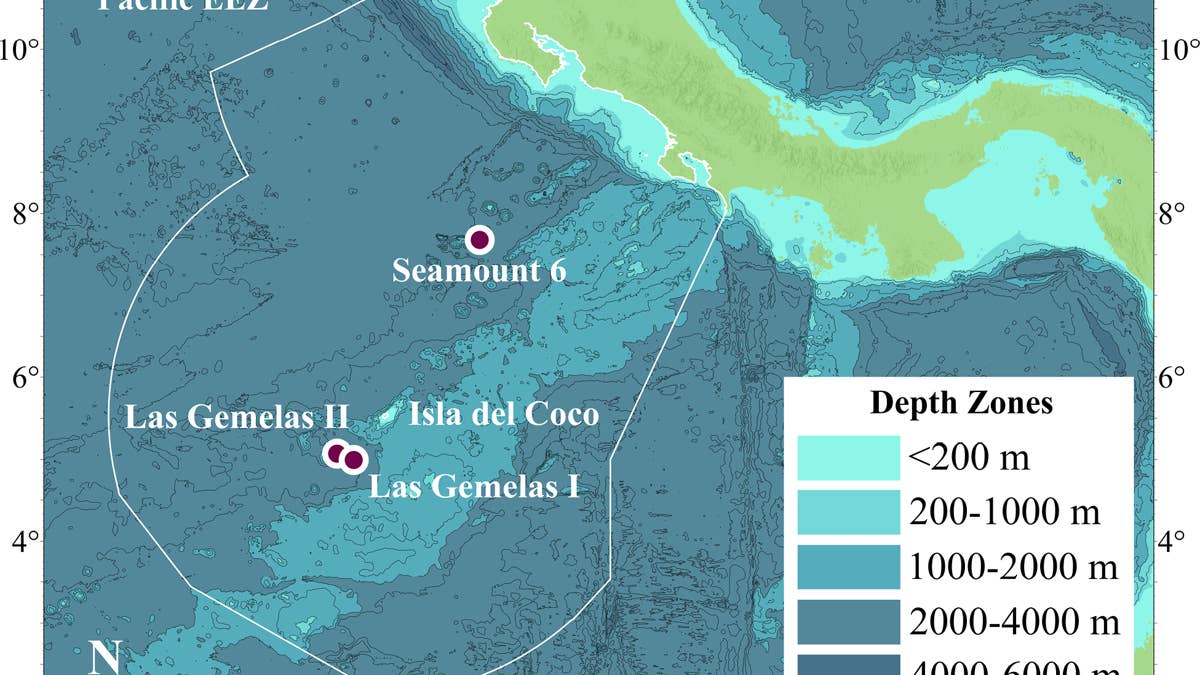
Scientists led by Lead Researcher Dr Odalisca Breedy, an octocoral specialist at the University of Costa Rica, first spotted the coral garden near Isla del Coco back in 2019. The organism was sitting in 500 metres of water, off the rugged volcanic island in the Pacific Ocean, 330 miles southwest of the Costa Rican mainland. Individual colonies were around three feet tall, and dense numbers grew on rocky outcrops almost entirely blanketed in brittle stars, each with distinctive glowing golden trees rising out of it.
The team from Schmidt Ocean Institute collected samples using a remotely operated vehicle across two separate expeditions in 2019 and 2023. Breedy had initially suspected it might fit into a known family, but couldn’t match it to anything. After exhaustive molecular and genome analysis, she discovered why. The coral was genetically and anatomically distinct enough that it required an entirely new family, genus, and species. Researchers rarely get to classify one of those in their career, let alone all three at once.
In surfing terms, it would be like finding the equivalent of an unridden Padang Padang or Cloudbreak on an unknown archipelago, on a just-found continent, and you get to name all of ‘em. Breedy didn’t opt for names like Spot X, The Snake or The Right; she instead took inspiration from Quenya, the Elvish language J.R.R. Tolkien devised for The Lord of the Rings. Which, in no way, plays into science stereotypes. She called the genus Laurinque (Golden Tree in Quenya), the species Elenya (the Elvish for star) and the family Laurinqueidae.
In an age of hyper-information and detailed and much-needed analysis of the effects of climate change and coral bleaching, their finding was a solid reminder of how little of the deep ocean has actually been surveyed. This was an entire undescribed branch of the coral family tree located on seamounts at a relatively modest 400 feet down, not some inaccessible ocean trench. Costa Rica’s Pacific seamounts are turning out to be a genuine deep-sea biodiversity hotspot, and we can look to more octocoral species to be discovered in the region in the coming years. Whether they’ll be named in Elvish remains to be seen.
Related: Could a Hurricane Hit Southern California Over Labor Day Weekend?